+91 84849 90676
.cd78382e.png&w=48&q=75) info@artigenius.com
info@artigenius.com



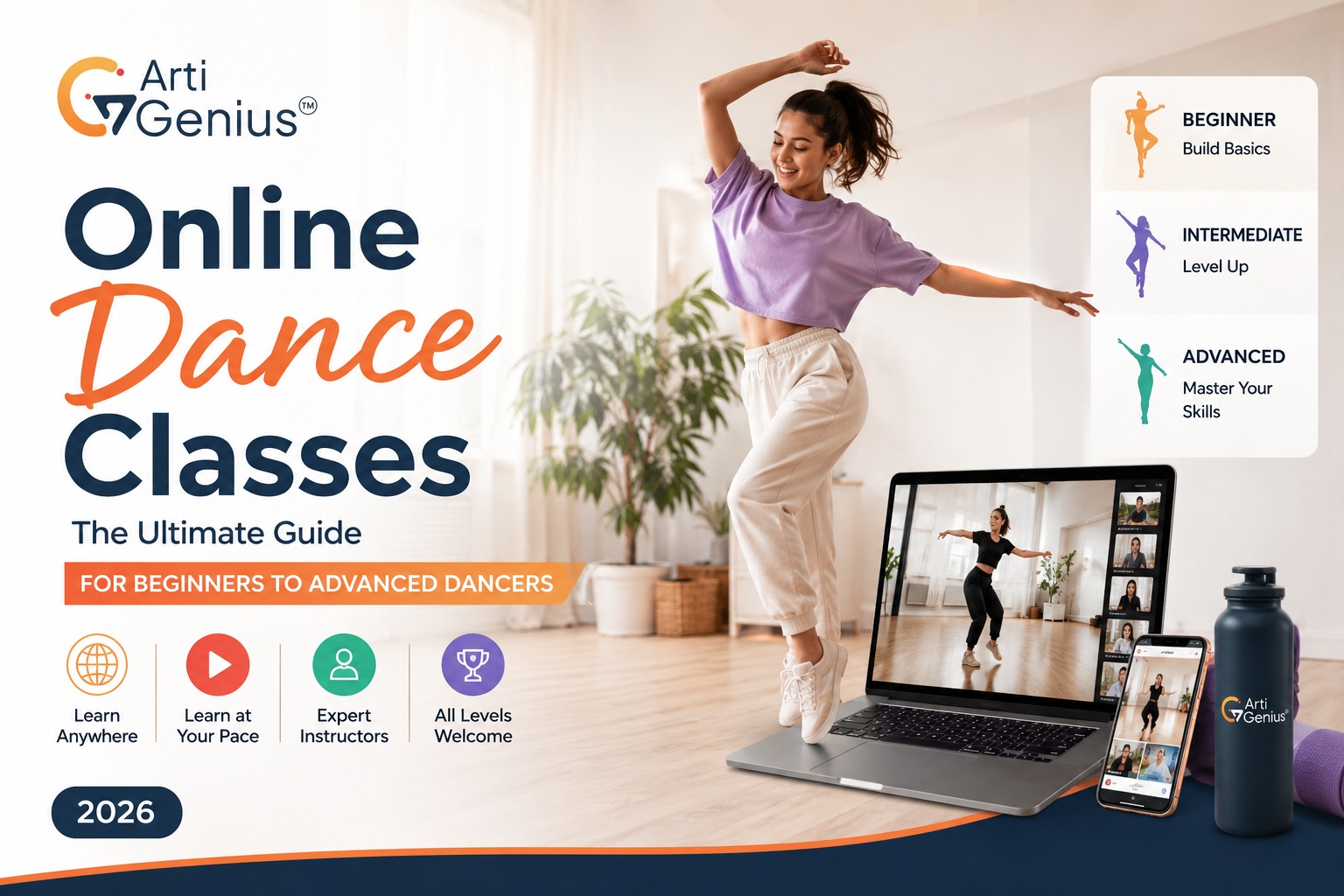
You Don't Need a Studio to Become a Dancer
Here's something most people don't tell you when you first Google "how to learn dance": you don't need a fancy studio, expensive gear, or even a lot of space. What you need is a little bit of courage, a screen, and the right guidance.
Online dance classes have completely changed the way people learn to move. Whether you're a complete beginner who's never taken a single step in rhythm, or someone who danced for years and wants to get back into it — learning dance online has never been more accessible, more affordable, or honestly, more fun.
This guide is your starting point. We've pulled together everything you need to know — from choosing the right dance style and platform, to what to wear, how to set up your space, and what to realistically expect in your first few weeks. No fluff. Just real, practical help.
Let's get into it.
What Are Online Dance Classes, Exactly?
Online dance classes are structured lessons taught through a screen — either live via video call or pre-recorded and available on demand. You follow along with an instructor in real time or at your own pace, from wherever you happen to be.
Some platforms run full courses with progressive levels, weekly live sessions, and even feedback from instructors. Others are more casual — think YouTube tutorials you can dip in and out of whenever you feel like it.
The format has evolved a lot over the past few years. What started as a pandemic workaround has turned into a genuinely preferred way to learn for millions of dancers around the world. And honestly? It makes a lot of sense. You get to practice without self-consciousness, pause and rewind as many times as you need, and fit lessons around your real life.
---
Why Learn Dance Online? (The Real Advantages)
Let's be real — there are some things an in-person studio does better. The energy of a room full of dancers, the immediate corrections from an instructor who can physically see your posture — those things matter.
But online has some advantages that are hard to argue with:
You can learn at your own pace.
Nobody's watching you stumble through the same eight-count fifteen times. You can rewind, pause, and repeat without embarrassment.
It fits into your actual schedule.
No commuting, no fixed class times (unless you choose live sessions), and no guilt about missing a class because life got in the way.
It's significantly more affordable.
In-person studios in major cities can cost 1000 - 1500 Rupees per month. Quality online platforms often run 800-1000 Rupees a month for unlimited access.
The variety is unmatched.
Want to do Afrobeats at 6am, then switch to ballet the following week? Online, you can. You're not locked into a single style or instructor.
You can practice in a judgment-free space.
This one matters more than people admit. Many beginners hold back in group classes because they feel watched. At home, you can really let go.
---
Choosing Your Dance Style: What's Right for You?
This is where most beginners get stuck — and it's completely understandable. There are dozens of dance styles out there, each with its own energy, technique, and learning curve. Here's a quick breakdown of the most popular ones you'll find in online classes:
Ballet
Ballet is one of the most technically demanding styles, but starting online as a total beginner is absolutely possible. It builds incredible body awareness, posture, and strength. If you want to eventually learn other styles too, a foundation in ballet actually helps across the board.
Best for: People who want structure, discipline, and a long-term physical challenge.
Learning curve: Steeper, but deeply rewarding.
High energy, expressive, and endlessly cool — hip-hop dance is one of the most popular styles learned online, and for good reason. It's accessible, the music keeps you motivated, and the community around it is incredibly welcoming to newcomers.
Best for: Anyone who loves music and wants to feel confident moving.
Learning curve: Approachable for beginners, with room to grow into advanced levels.
Salsa & Latin Dance
Salsa, bachata, and cha-cha are social dances at their core — but you can absolutely learn the foundations solo online. Footwork, timing, and rhythm are the focus in the early stages, and many people find these styles become a genuine lifestyle.
Best for: People who want to eventually dance socially or with a partner.
Learning curve: Moderate — timing takes practice, but the basics come quickly.
Contemporary Dance
Contemporary is one of the most expressive forms of dance, blending elements of ballet, jazz, and modern movement. It's physically demanding but also deeply personal — you'll develop your own movement vocabulary over time.
Best for: Creative, expressive people who want more than just choreography.
Learning curve: Moderate to high, depending on your background.
Bollywood
Bollywood dance is joyful, colourful, and genuinely infectious. It draws from classical Indian styles, folk traditions, and modern film choreography. Online classes are plentiful and beginner-friendly.
Best for: Anyone who wants high-energy, expressive movement with cultural depth.
Learning curve: Low to moderate for basics — very welcoming to beginners.
Tap Dance
Tap is rhythm made physical. Your feet become the instrument, and there's a genuine musicality to the style that hooks people immediately. You'll need tap shoes, but beyond that, you can learn entirely from home.
Best for: Music lovers, people who like precision and rhythm challenges.
Learning curve: Moderate — it takes time to train your feet, but early progress feels great.
Who Can Learn Dance Online?
Short answer: pretty much anyone. Let's break it down by group.
Complete Beginners
If you've never taken a dance class in your life, online is actually one of the best places to start. You get to build confidence privately before you ever have to dance in front of another person. Look for beginner-specific playlists and courses that assume zero prior knowledge.
Kids (Ages 3–12)
Online dance classes for kids have come a long way. Many platforms and YouTube channels are specifically designed for young learners — with bright visuals, short lesson segments, and simple, age-appropriate choreography. Children tend to pick up movement quickly and absolutely love learning at home with the freedom to be silly.
Teenagers
Teens tend to be motivated by specific styles — hip-hop, K-pop, and street dance are consistently the most popular. They're also highly independent learners, which makes the self-paced format a natural fit.
Adults (All Ages)
There is no age at which it's "too late" to start dancing. Adults bring things to the dance floor that younger learners don't — patience, emotional maturity, and a clearer understanding of why they want to dance. Whether you're 25 or 65, online classes are designed to meet you where you are.
Seniors
Low-impact styles like gentle ballroom, chair-based movement, and slower contemporary flows are widely available online. Dancing is one of the most well-researched activities for maintaining coordination, cognitive function, and mood in older adults. Many seniors find it becomes one of the highlights of their week.
People Returning After a Break
If you danced when you were younger and then life got in the way — online classes are a beautiful way back in. You'll be surprised how quickly your body remembers.
How to Choose the Right Online Dance Platform
Not all platforms are equal, and the right one depends on what you're looking for. Here's what to consider:
Teaching style:
Do you want highly structured, progressive lessons — or the freedom to jump between styles and teachers? Some platforms are more like courses; others are more like a library you explore freely.
Live vs. on-demand:
Live classes give you real-time energy and sometimes instructor feedback. On-demand lets you go at your own speed. Many platforms now offer both.
Your budget:
Free options (mainly YouTube) are genuinely solid for many styles and levels. Paid platforms typically offer better structure, more variety, and a stronger sense of community.
Trial periods:
Most reputable paid platforms offer a free trial. Always use it before committing.
Instructor credentials:
Look for instructors with real performance or teaching backgrounds. Good platforms will have instructor bios — read them.
Community features:
If you're the kind of person who thrives with accountability and connection, look for platforms with forums, challenges, or live Q&A sessions.
---
Free vs. Paid Online Dance Classes: An Honest Look
There's a lot of genuinely excellent free content out there. YouTube, in particular, has world-class dance instructors posting full tutorials at no cost. If you're testing the waters, starting there makes complete sense.
The trade-off is structure. Free content is rarely organised into a clear learning path. You might find a great beginner tutorial for salsa, then struggle to find where to go next. You might jump between instructors with different teaching styles and feel like you're not actually building skills.
Paid platforms solve that problem. You follow a curriculum. You progress in a logical order. You build on what you learned last week. That kind of structure makes a bigger difference than most people expect — especially beyond the beginner stage.
Our honest recommendation:
Start free to figure out what style you love. Once you know, invest in a structured platform to actually develop your skills.
---
Setting Up Your Home Dance Space
One of the biggest excuses people make for not starting is "I don't have enough space." Here's the truth: you need less than you think.
Floor space:
A 6x6 foot clear area is enough for most beginner routines. Move your coffee table, roll up the rug if you have one, and you're probably there.
Flooring:
Hardwood or laminate is ideal. Carpet makes footwork harder. If you're learning tap, you'll want a hard surface. Most other styles are fairly forgiving.
Your screen setup:
You want your screen at roughly eye level and far enough back that you can see the instructor's full body. Propping your laptop on a stack of books or getting a simple phone stand makes a big difference.
Mirrors:
Not essential, but genuinely useful. Even a single full-length mirror lets you check your own form without needing to film yourself constantly.
What to wear:
Comfortable, form-fitting clothes you can move freely in. For most styles, trainers with a smooth sole work well. Ballet needs soft ballet shoes. Tap needs tap shoes. Everything else — wear what you'd wear to the gym.
---
What to Expect in Your First Month
Let's set realistic expectations, because the first few weeks of learning any dance style can feel discouraging — and that's completely normal.
Week 1–2:
Everything feels awkward. Your brain is learning movement patterns it's never encountered before, and your body takes time to catch up. This is not a sign you're a bad dancer. This is just what learning feels like.
Week 3–4:
You'll notice the first glimpses of things clicking. A sequence you kept stumbling over will suddenly flow. Your timing will start to feel more natural. This is the moment most people fall in love with dancing.
Ongoing:
Progress isn't linear. You'll have weeks that feel effortless and weeks where you feel like you've gone backwards. Both are part of the process. The dancers who improve fastest are the ones who show up consistently — not the ones who are naturally talented.
One practical tip:
Record yourself from the beginning, even though it'll feel uncomfortable. Watching your own progress over a few months is one of the most motivating things you can do.
---
Online Dance Classes for Fitness and Weight Loss
Dance is one of the most underrated forms of exercise — and one of the most sustainable, because it doesn't feel like a workout when you're having fun.
Depending on the style and intensity, a 45-minute dance session can burn anywhere from 200 to 600 calories. Zumba and hip-hop cardio routines sit at the higher end. Ballet barre and contemporary tend to be lower in cardio but exceptional for strength and flexibility.
Beyond calories, dance improves coordination, balance, posture, spatial awareness, and cardiovascular health. It also does something that most gym workouts don't: it genuinely improves your mood. The combination of music, movement, and creative expression has a measurable effect on mental wellbeing.
If your goal is fitness, look for platforms that offer dance cardio or fitness-focused routines specifically. Many fitness apps now include dance workouts designed for calorie burn and cardiovascular improvement.
---
Online Dance Classes for Special Occasions
Wedding Dance
Learning your first dance online is one of the most popular reasons couples look into dance classes. Most platforms have beginner-friendly wedding dance courses, and many offer private virtual lessons with instructors. Give yourself at least 8–12 weeks for a polished result.
Performance Prep
If you're preparing for a school show, an audition, or a performance, online classes can provide the technical foundation. Supplement with live feedback from an instructor where possible — either through a virtual 1:1 session or a local class.
Social Dance Events
Salsa nights, swing dance events, bachata socials — these happen in cities all over the world, and you absolutely can prepare for them online. The fundamentals of partner dancing translate well from screen to floor.
---
How Much Do Online Dance Classes Cost?
Here's a realistic breakdown of what you can expect to pay:
Free (YouTube and similar):
₹0. Excellent for exploration, patchy on structure.
Budget platforms:
₹800–₹1000/month. Good variety, usually self-guided.
Mid-range platforms:
₹1000–₹1200/month. Structured courses, multiple styles, sometimes community features.
Premium platforms:
₹1500–₹2000/month. High production quality, live classes, instructor access, broader library.
Private virtual lessons:
₹2000–₹2500+ per session, depending on the instructor's profile and experience.
For most people, a mid-range platform plus supplementary free YouTube content is the sweet spot — great value without sacrificing quality.
---
Tips to Actually Stick With It (From People Who Have)
Starting is easy. Sticking with it is where most people struggle. Here's what genuinely helps:
Set a specific time.
"I'll practice when I have time" means you'll never practice. Book it in your calendar like any other appointment.
Start small.
Three 20-minute sessions a week will get you further than two 90-minute sessions you keep skipping. Consistency beats intensity.
Pick music you love.
This sounds obvious but it's underestimated. When you genuinely enjoy the music, practice stops feeling like a chore.
Find one person to share it with.
A friend who's also learning, or even just someone who checks in on your progress, makes a surprising difference.
Give yourself at least 30 days before judging.
The first few weeks are the hardest. Almost everyone who pushes past them is glad they did.
---
Frequently Asked Questions
Can I really learn to dance properly online?
Yes — with the right structure and consistent practice. Many working dancers started online, and the quality of teaching available has improved dramatically.
Do I need any dance experience to start?
Not at all. Every style has beginner-level courses that assume zero prior experience.
How much space do I need at home?
A roughly 6x6 foot clear area works for most beginner routines. You don't need a dedicated dance room.
How long before I see real improvement?
Most people notice genuine improvement within 4–6 weeks of regular practice (3+ times per week).
What's the best style to start with as a total beginner?
It depends on your goals. Hip-hop and Latin dance (salsa, bachata) are widely considered the most beginner-friendly. Ballet is harder but builds the strongest foundation.
Are there online dance classes for older adults?
Absolutely. There are classes designed specifically for seniors, including low-impact options and chair-based movement programs.
---
Final Thoughts: Your Dance Journey Starts Here
Here's the thing about dancing — everyone starts somewhere, and that somewhere is almost always uncomfortable. The people who look effortless on the dance floor today were once exactly where you are: watching a tutorial, stumbling through an eight-count, wondering if they were cut out for this.
They were. And so are you.
Online dance classes have genuinely democratised something that used to feel exclusive — movement, expression, rhythm, joy. All of it is now available to you, from your living room, at whatever time works for your life.
The hardest step is the first one. Take it.
---
Explore more guides in this series:
- Best Online Dance classes in Summers for kids to stay active
- How to Set Up Your Home Dance Space
- Online Dance Classes for Weight Loss & Fitness
- Wedding Dance Classes Online: A Couples' Guide
- Hip Hop vs Bollywood Dance — Which Should Your Child Learn First?