+91 84849 90676
.cd78382e.png) info@artigenius.com
info@artigenius.com



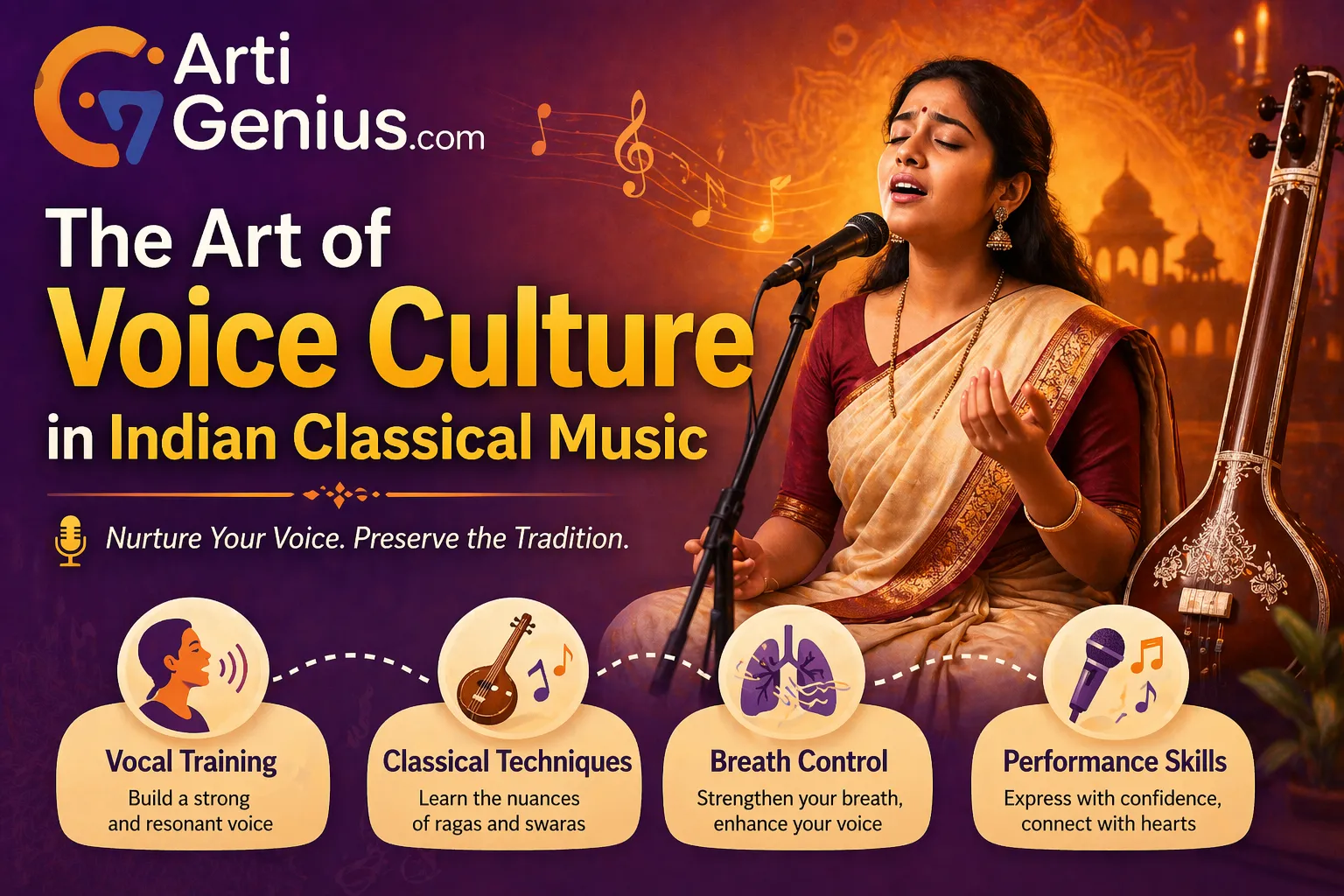
Indian classical music is a profound and ancient tradition that has evolved over thousands of years. Central to this tradition is the concept of voice culture, which refers to the training and refinement of the voice to meet the exacting demands of classical performance. Voice culture encompasses various techniques and practices that help vocalists enhance their vocal range, flexibility, tonal quality, and overall expressiveness. This blog explores the significance, methods, and benefits of voice culture in Indian classical music.
The Importance of Voice Culture
In Indian classical music, the voice is not merely an instrument but a medium for expressing the deepest emotions and spiritual experiences. A well-cultivated voice can convey the subtleties of ragas (melodic frameworks) and talas (rhythmic cycles) with precision and grace. The practice of voice culture enables singers to:
1. **Maintain Vocal Health:** Proper training helps in preventing vocal strain and damage, ensuring a long and healthy singing career.
2. **Expand Vocal Range:** Singers can develop the ability to sing comfortably across a wide range of pitches.
3. **Enhance Tonal Quality:** Voice culture techniques refine the tone, making it richer and more resonant.
4. **Improve Flexibility and Agility:** A trained voice can navigate complex melodic patterns and fast-paced passages with ease.
5. **Achieve Emotional Expression:** Mastery over the voice allows singers to convey deep emotions and connect with the audience.
Techniques and Practices in Voice Culture
Voice culture in Indian classical music involves a holistic approach that integrates physical, mental, and spiritual practices. Here are some key techniques and methods:
1. **Breathing Exercises (Pranayama)**
Breathing control is fundamental to good singing. Pranayama, the ancient practice of breath control in yoga, is often incorporated into voice training. Techniques such as **deep diaphragmatic breathing**, **alternate nostril breathing (Anulom Vilom)**, and **Kapalbhati** help in developing breath support and control, which are crucial for sustaining long phrases and maintaining pitch stability.
2. **Voice Warm-ups**
Warming up the voice is essential to prepare the vocal cords for singing. Common warm-up exercises include:
- **Aakar Practice:** Singing the vowel "aa" in various pitches and scales to loosen and warm up the vocal cords.
- **Sargam Practice:** Singing the solfège (sa, re, ga, ma, pa, dha, ni, sa) to develop pitch accuracy and agility.
- **Kharaj Practice:** Practicing the lower octave notes to strengthen the lower range of the voice.
3. **Swara Sadhana (Note Practice)**
Swara Sadhana involves intensive practice of individual notes (swaras) to achieve perfect intonation and control. This includes:
- **Sustained Note Practice:** Holding a single note for an extended period to develop control and steadiness.
- **Gamaka Practice:** Practicing oscillations and ornamentations around notes to add expressiveness and emotion.
4. **Alankar Practice**
Alankars are patterns of notes that help in building speed, accuracy, and flexibility. Practicing alankars in various ragas and speeds is a common method to enhance technical skills.
5. **Voice Modulation and Dynamics**
Learning to control the volume and intensity of the voice is crucial for expressive singing. This includes practicing:
- **Meend (Gliding):** Smoothly transitioning between notes.
- **Khatka and Murki:** Quick, ornamental note sequences.
- **Taan Practice:** Fast, intricate patterns of notes.
6. **Regular Riyaaz (Practice)**
Consistent and disciplined practice, or riyaaz, is the cornerstone of voice culture. It involves dedicating time every day to practice scales, ragas, compositions, and improvisations.
Benefits of Voice Culture
The rigorous practice of voice culture yields numerous benefits for singers:
1. **Improved Vocal Stamina:** Singers can perform for longer periods without fatigue.
2. **Greater Musical Expression:** A well-trained voice can convey a wide range of emotions and nuances.
3. **Enhanced Performance Quality:** Audiences can experience the full depth and beauty of the music.
4. **Professional Growth:** Mastery of voice culture techniques can open up more opportunities in performance and teaching.
Conclusion
Voice culture is an integral part of Indian classical music, deeply rooted in the tradition's emphasis on discipline and devotion. Through a combination of breathing techniques, vocal exercises, and regular practice, singers can develop a voice that is not only technically proficient but also capable of expressing the profound emotions and spiritual essence of Indian classical music. Whether you are a novice or an experienced vocalist, embracing the art of voice culture can significantly enrich your musical journey.