+91 84849 90676
.cd78382e.png) info@artigenius.com
info@artigenius.com


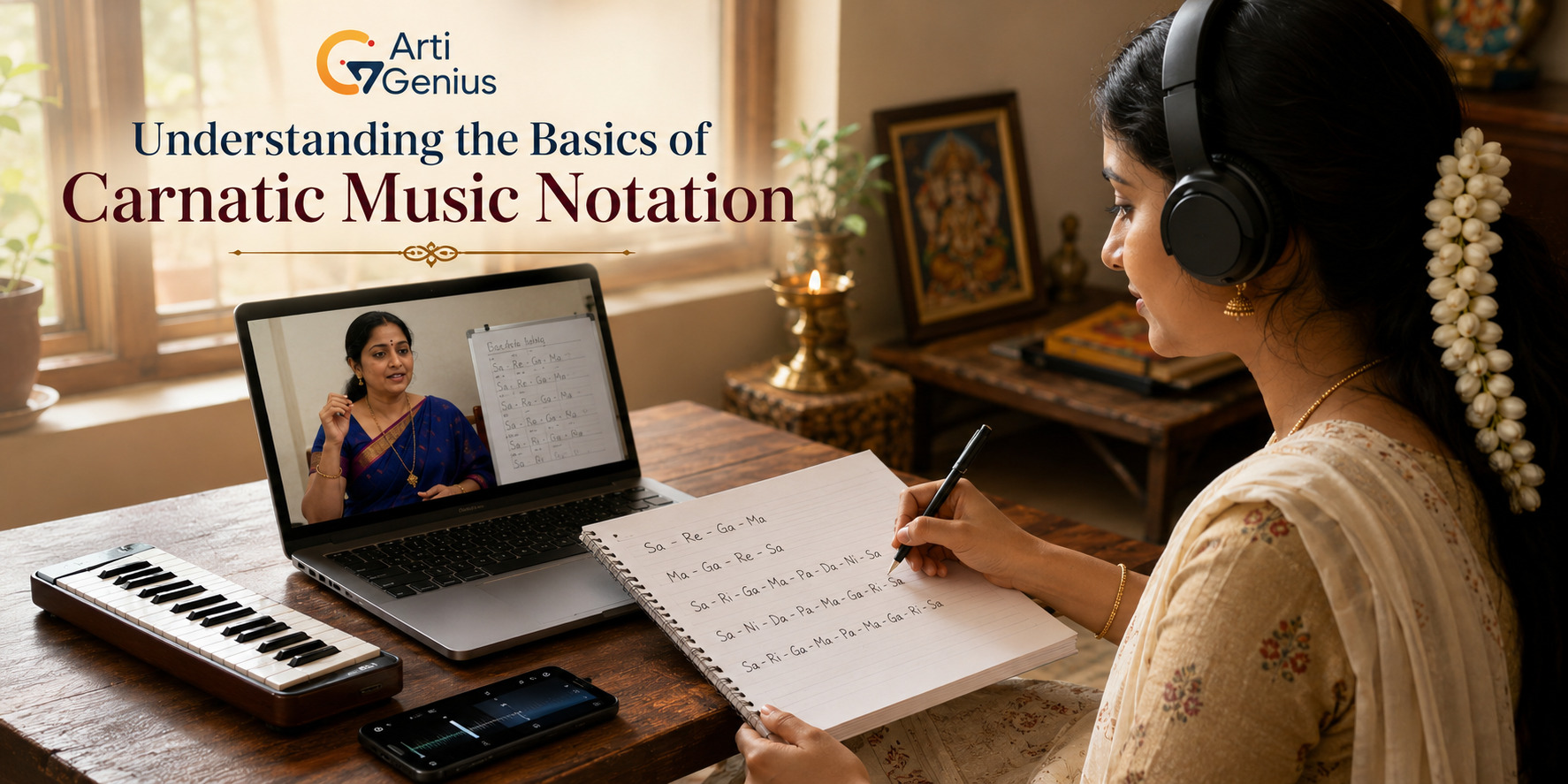
Carnatic music is one of the oldest and most respected forms of Indian classical music. Known for its depth, structure, and emotional expression, it combines melody, rhythm, devotion, and creativity in a highly organised way.
For beginners, one of the first major concepts to understand is notation. At first, Carnatic notation may look technical because it uses swaras, rhythmic divisions, and symbolic patterns instead of Western-style sheet music. However, once you understand the basics, it becomes much easier to learn songs, practise ragas, and improve rhythm control.
Today, many students are learning these fundamentals through online Carnatic singing classes, where lessons are broken down step by step using practical examples and guided exercises.
What Are Carnatic Music Notes?
The foundation of Carnatic music begins with seven basic swaras:
- Sa
- Ri
- Ga
- Ma
- Pa
- Da
- Ni
These are similar to the “Do Re Mi” system in Western music. In notation form, they are written as:
- S
- R
- G
- M
- P
- D
- N
However, Carnatic music becomes more detailed because certain swaras have multiple variations.
For example:
- Ri has R₁, R₂, R₃
- Ga has G₁, G₂, G₃
- Da has D₁, D₂, D₃
- Ni has N₁, N₂, N₃
These subtle differences are what create different ragas and emotional expressions.
Students attending online music classes usually begin by listening to these swaras repeatedly before learning how they are written and identified in notation.
Understanding Carnatic Music Notation
Carnatic notation is a written method used to represent melody and rhythm together.
It helps learners understand:
- Swara placement
- Pitch movement
- Tala structure
- Song patterns
A simple ascending scale looks like this:
S R G M | P D N S
And the descending scale looks like:
S N D P | M G R S
Here:
- “|” represents beat division
- “||” represents the end of a rhythmic cycle
Dots above or below notes indicate higher and lower octaves.
For example:
- A dot below a swara indicates lower octave
- A dot above a swara indicates higher octave
Unlike Western notation, Carnatic notation is based on relative pitch. This means “Sa” can begin from any base note depending on the singer’s comfort.
This flexibility is one reason Carnatic music feels highly personalised.
Learning Carnatic Notes on Keyboard
Many modern learners use keyboards to understand Carnatic swaras visually.
This approach helps beginners identify pitch relationships more easily.
For example, if “Sa” is assigned to the note C on a keyboard:
- Sa = C
- Ri₁ = C#
- Ga₃ = E
- Ma₁ = F
- Pa = G
- Da₁ = G#
- Ni₃ = B
Practising swaras on a keyboard helps students:
- Improve pitch accuracy
- Understand intervals visually
- Practise ragas more systematically
Students learning through online singing classes often combine vocal exercises with keyboard practice to strengthen musical understanding.
How Swaras and Talas Work Together
Carnatic music is not only about melody. Rhythm also plays a major role.
Every composition is built using:
- Raga (melodic structure)
- Tala (rhythmic cycle)
One of the most common talas beginners learn is Adi Tala, which follows an 8-beat cycle.
Notation helps students understand where each swara fits rhythmically.
For example:
| S R G M | P D N S |
The spacing between notes helps indicate timing and duration.
Teachers in online Carnatic singing classes often use clapping techniques and hand movements to help students physically understand rhythm instead of just memorizing it.
This combination improves both timing and coordination.
Beginner Exercises in Carnatic Music
Every beginner starts with basic exercises that build voice control and swara clarity.
The most common beginner exercises include:
Sarali Varisai
Simple ascending and descending note patterns.
Example:
S R G M | M G R S
Janta Varisai
Double-note exercises that strengthen swara stability.
Example:
S S R R G G
Alankaras
Rhythmic exercises practised in different talas.
These exercises help students:
- Improve pitch accuracy
- Build rhythm discipline
- Develop smoother voice movement
- Understand notation practically
Most beginners learn these exercises in the raga Mayamalavagowla because its structure is balanced and easier for foundational training.
Reading Carnatic Notes for Songs
Once students become comfortable with basic exercises, they move to songs like Geetams, Varnams, and Kritis.
Notation becomes extremely useful at this stage because it helps learners break songs into manageable sections.
For example, a simple notation pattern in a kriti may look like:
S R₂ G₃ P N₃ S |
This allows students to identify:
- Swara movement
- Rhythm placement
- Raga structure
However, notation alone is not enough.
Carnatic music depends heavily on listening, repetition, and expression.
That is why teachers combine notation with live demonstrations during lessons.
Common Mistakes Beginners Make
Most beginners face similar challenges while learning notation.
Here are common mistakes:
- Memorizing notation without listening carefully
- Ignoring tala while practising swaras
- Practising too fast
- Depending entirely on written notes
- Skipping basic exercises
One important thing to remember is that notation supports learning, but it does not replace musical listening.
Consistent practice and repetition are essential.
Learning Through Online Carnatic Singing Classes
Traditional Carnatic learning remains highly respected, but online learning has made music education more flexible and accessible.
Today, online Carnatic singing classes offer:
- Live guided sessions
- Recorded lessons for revision
- Digital notation sheets
- Personalized feedback
- Flexible schedules
Students who want structured online Hindustani music classes or Carnatic lessons can explore ArtiGenius, which offers flexible online classes and expert guidance.
This format is especially useful for beginners because they can revisit lessons multiple times and practise at their own pace.
How Long Does It Take to Learn Carnatic Notation?
This depends on consistency.
Most students understand basic notation within a few weeks.
However, becoming fully comfortable with ragas, rhythm patterns, and advanced compositions takes longer.
A typical learning path looks like this:
- First few weeks: Swaras and simple notation
- 1 to 3 months: Basic exercises and rhythm understanding
- 6 months onward: Better fluency with songs and ragas
The focus should always be clarity, not speed.
Conclusion
Carnatic music notation is one of the most important foundations in classical music learning.
It helps students understand swaras, rhythm, ragas, and compositions more clearly.
While it may feel difficult initially, regular practice makes it easier over time.
That is why online Carnatic singing classes are becoming a practical option for modern learners. They combine flexibility, guided learning, visual explanations, and structured practice in a beginner-friendly way.
Once you start understanding notation properly, learning Carnatic music becomes much more enjoyable and meaningful.